Blog
Assisted transfer, hold and conference
Three actions, one structure. What an assisted transfer really does, why hold breaks so often, and the term Quebec's language office actually recommends.
John · Owner and CEO · 2 min read · · updated
Moving a live call means three actions: park it, hand it off, or bring a third person in. On a well-built system those are three ways of operating on one thing. On many systems they are three separate mechanisms, which is why one of them always fails.
Is it an assisted transfer or a supervised one?
In Quebec the term is transfert d'appel assisté. The Office québécois de la langue française has it on file that way.
Transfert supervisé is the France term, and it is what you will read in almost all French-language documentation online, because that documentation is written in France. If you are writing procedures for a Quebec team, the Office's term is the one in use here.
The distinction itself is simple:
- Blind transfer: you send the call and hang up. The caller arrives on someone who is not expecting them.
- Assisted transfer: you speak to the destination first, introduce the caller, then step out.
The second is the one people want and the one systems get wrong.
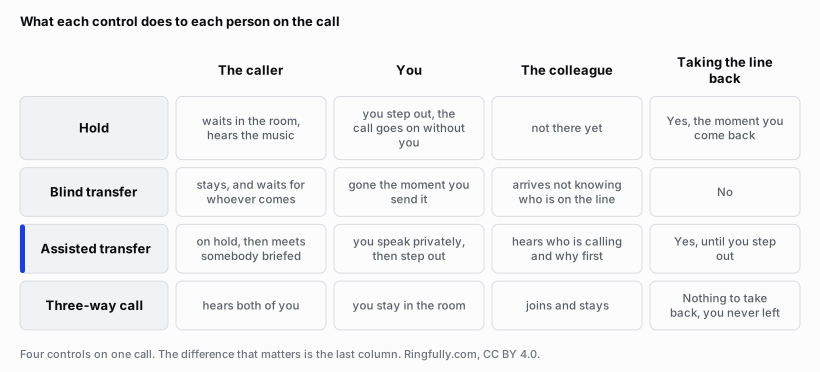
Four controls on one call: the last column is the whole difference between a blind transfer and an assisted one.
Reuse this figure anywhere, including commercially, with credit to Ringfully and a link back to this page. CC BY 4.0.
Why does hold break so often?
Hold breaks because the call has to keep existing without you while it happens, and on a system where a call is a direct bridge between two points, removing one end threatens the bridge.
Hence the familiar symptoms: music that never resumes, the caller dropped after thirty seconds, the transfer that lands nowhere when the destination does not answer.
That is an architecture problem, not a configuration one. We wrote it up in full in why the transfer is the hard part.
Conference is not a separate feature
If a call lives in a room rather than on a wire stretched between two people, a three-way call is not an extra feature: it is a third person walking into the room.
That is how Ringfully is built. Every answered call is bridged into its own conference the moment it connects, and hold, blind transfer, assisted transfer and three-way merge are four ways of operating on that room. The difficult transfer behaves like the easy one because it is the same mechanism. What each of those four buttons does to the room is on answering and transferring.
What to put in your procedures
Two sentences prevent most bad transfers:
- Announce before you step out. "I have Ms. Tremblay about an invoice" beats leaving the destination to work it out.
- Take the line back if nobody answers. An assisted transfer lets you return; a blind one does not. That is the whole difference.
For how a call is routed before a human picks it up, see queues and skills-based routing. Before the transfer, the menu had already decided who should have the call: one number, different people. If transfers drop on your line today, describe what happens and we will say whether this is the reason.
Questions people ask
- Is it transfert d’appel assisté or transfert supervisé in Quebec?
- Transfert d’appel assisté. That is the term the Office québécois de la langue française records, with warm transfer as the English equivalent. Transfert supervisé comes from documentation written in France, so it is the wrong one to put in a procedure for a Quebec team.
- Can I introduce the caller before transferring them?
- Yes. Put the caller on hold, speak to the colleague privately for as long as you need, then step out. The caller comes back to somebody who already knows who they are and why they called. Staying instead of stepping out turns the same action into a three-way call.
- Why does hold break on so many phone systems?
- Because the call has to keep existing without you while you are away from it, and on a system where a call is a bridge between two points, removing one end threatens the bridge. That is what produces music that never resumes and callers dropped after thirty seconds.
- Is a three-way call a separate feature?
- Not here. Every answered call is already a conference of its own, so a third person is somebody walking into a room that already exists. Hold, a blind transfer, an assisted transfer and a merge to three are four operations on that one room.
- What should our procedure say about transfers?
- Two lines cover most of it. Announce the caller before you step out, naming who they are and what they want. And take the line back if nobody answers, which an assisted transfer allows and a blind one does not.
About the author
John
Owner and CEO
Owner and CEO with over 10 years of experience in the IT industry, including more than 5 years specializing in VoIP and cloud communications. Experienced in designing, deploying, and supporting reliable communication solutions for businesses.

Keep reading
If callers get lost in the transfer, tell us how a call moves between your people today, and we will show you the same buttons in our app.