Blog
Why call transfers drop, and what fixes it
Most phone systems make answering easy and transferring fragile. A call built as a point-to-point bridge has nowhere to put a third person, so it drops one.
John · Owner and CEO · 4 min read · · updated
Every phone system demo shows the same thing. A call arrives, somebody answers, the audio is clear. It is the easy part, and it is the part everyone tests.
The hard part comes forty seconds later, when the person who answered realizes the caller needs somebody else. What happens next is where phone systems quietly differ, and it is worth understanding why, because the difference is not a feature list, it is a decision made long before anyone pressed transfer.
Two ways to build a call
The obvious way to connect two people is to bridge their two legs directly. The caller's line is joined to the agent's line, audio flows, and the system holds a reference to that pair. It is simple, it is cheap, and it works perfectly right up until you need a third participant.
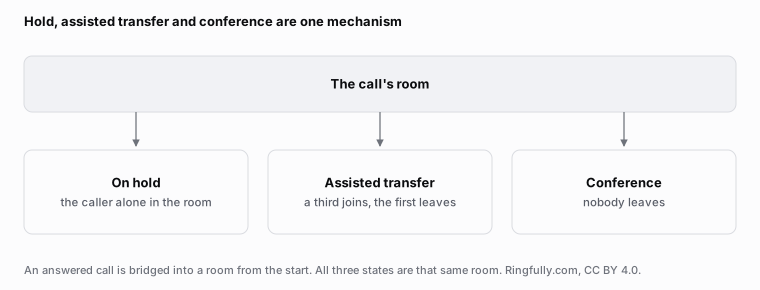
Hold, an assisted transfer and a three-way call are the same conference room, which is why they behave the same way every time.
Reuse this figure anywhere, including commercially, with credit to Ringfully and a link back to this page. CC BY 4.0.
Because now the bridge has to be torn down and rebuilt. The caller is put on hold (usually by parking them somewhere else entirely), a new call is placed to the second agent, and if that agent answers, a new bridge is constructed. If they do not answer, the system has to find its way back to the original state. Every one of those steps is a place to lose the caller, and "the transfer dropped the call" is the single most common complaint about business phone systems for exactly this reason.
The second way is to decide, up front, that a call is not a pair of legs. It is a room.
A room from the first second
In Ringfully every answered call is bridged into a conference the moment it connects: inbound or outbound, one participant or five. There is no point-to-point mode. A call with one agent and one caller is a room with two people in it.
That sounds like overhead for the common case, and it is, slightly. What it buys is that every subsequent operation stops being a special case:
| Operation | In a point-to-point system | In a room |
|---|---|---|
| Hold | Park the caller elsewhere, remember where | Mute one participant |
| Blind transfer | Tear down, redial, rebuild | Add one participant, remove another |
| Consult transfer | Two bridges and a hold, carefully sequenced | Hold one, add another, they talk |
| Add a third person | Usually not supported | Add one participant |
| Recording | Attach to a bridge that may be replaced | Attach to the room |
None of those are features that had to be built separately. They are the same operation (add or remove somebody from a room) expressed five ways. What that looks like from the desk is on answering and transferring.
The part that is genuinely subtle
Rooms have to be named, and the name is where this design usually goes wrong.
The tempting choice is to name the room after the telephony provider's own call identifier, because it is right there in the webhook. It is also the wrong choice, and the reason is timing: for an outbound call you do not have that identifier until the call has already been created, which means the room has to be named after something that does not exist yet.
So Ringfully names the room after its own call record: an id it generates itself, known before anything is dialled, identical in both directions. The provider's identifier is looked up on demand when it is actually needed. It is a small decision that removes an entire category of race condition.
The same applies to who is allowed to end the room. When an agent hangs up on a consult that did not work out, the caller must not be disconnected, so only the external party's leg carries the flag that tears the room down. An agent leaving is just a participant leaving.
Why this shows up in a demo as "it just works"
It does not look like anything. Nobody watching a transfer succeed thinks about conference rooms. The architecture is only visible in its absence: in the half-second of silence before a transfer fails, in the caller who has to phone back, in the agent who has learned not to attempt a warm transfer because it drops one time in five.
The measure of a phone system is not whether it can answer a call. It is what it can do to a call already in progress, and that is decided by a choice made before the first line of routing logic was written.
Ringfully's call control is built on this model throughout. If you want the detail (participant scoping, why extension numbers are rejected before E.164 validation, how forwarding keeps a call in the same room), the how it works page walks the whole path a call takes. If your own transfers drop and you want to know whether this is why, tell us what happens on the call.
Questions people ask
- Why do call transfers drop?
- Because on most systems a call is a direct bridge between two lines, and adding a third person means tearing that bridge down and building a new one. The caller is parked somewhere else, a second call is placed, and every one of those steps is a place to lose them.
- What is the difference between a blind transfer and an assisted one?
- A blind transfer sends the call on and you hang up, so the colleague picks up with no idea who is on the line. An assisted transfer keeps you in the call while you speak to the colleague privately, and it lets you take the caller back if nobody answers.
- How does Ringfully avoid the dropped transfer?
- Every answered call, inbound or outbound, is put into a conference of its own the moment it connects. There is no point-to-point mode to break out of, so hold, a blind transfer, an assisted transfer and a three-way call are the same operation on one room: somebody joins, or somebody leaves.
- What happens if the colleague does not answer?
- Nothing was torn down, so you still have the caller. You leave the private leg and take your line back. Only the outside caller's leg carries the flag that ends the room, so a colleague hanging up is just a participant leaving.
- Does the caller notice any of this?
- Only when it is missing. A transfer that works looks like nothing at all. The architecture shows up in the half-second of silence before a failed one, and in the colleague who has quietly stopped attempting hand-overs because they drop.
About the author
John
Owner and CEO
Owner and CEO with over 10 years of experience in the IT industry, including more than 5 years specializing in VoIP and cloud communications. Experienced in designing, deploying, and supporting reliable communication solutions for businesses.

Keep reading
If callers get lost in the transfer, tell us how a call moves between your people today, and we will show you the same buttons in our app.