Blog
Moving your business number to another provider
The number belongs to you, not to your carrier. What porting actually requires in Canada, and the one mistake that loses a business number for good.
John · Owner and CEO · 3 min read · · updated
In Canada, local number portability is governed by the CRTC: your number follows you when you change providers. A business line needs a signed letter of authorization and a recent bill whose details match. One rule matters more than the rest.
Never cancel the old service before the port completes. A cancelled number returns to the carrier's pool, and it is not always recoverable. It is the only irreversible mistake in this process.
Why the advice you find does not apply
Search for number porting and you will get consumer mobile content (switching cell carriers and keeping your number) or French pages explaining the code RIO, which does not exist in Canada.
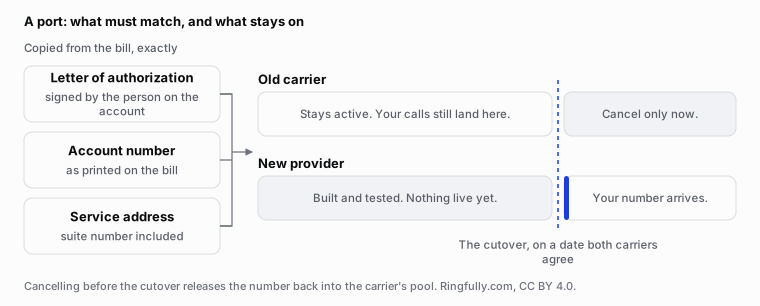
A port is two problems at once: details that have to match the bill, and an order that keeps the old line carrying calls until the cutover.
Reuse this figure anywhere, including commercially, with credit to Ringfully and a link back to this page. CC BY 4.0.
A business line does not work that way. The transfer is not instant, it usually involves several numbers at once, and it can break things a mobile plan does not have: a hunt group, a billing telephone number, an extension wired to a fax machine.
What does the new provider need from you?
Three things, and they have to match exactly what the old carrier has on file:
- A letter of authorization, signed by the person authorized on the account.
- A recent bill from the current provider.
- The account number and service address as they appear on that bill.
The most common cause of rejection is not a refusal: it is a mismatch. "123 Main St" against "123 Main Street, Suite 4" is enough to fail the request. Copy the bill, not your letterhead.
The mistake that costs a number
The instinct is understandable: nobody wants to pay two providers at once, so the old service gets cancelled the moment the new one is ready.
The number has to be active with the old carrier to be ported. Cancelling first releases it, and a released number can be reassigned. You will overlap by a few days. That is the cost of the insurance, and it is trivial next to reprinting cards, signage and every online business listing you have.
Partial ports
If you are moving only some of your numbers, say so explicitly. A group configured at the old carrier (a main number that overflows to three others) stops behaving like a group the moment half of it leaves.
This is the moment to decide what each number becomes: which one is the main line, which rings one person directly, and which no longer needs to exist.
What we do, and what we do not
We prepare the port with you: details checked before submission, routing built in advance, and nothing cut over until the number has actually arrived. There is no self-serve porting in the product today. This is something we run with you, not a button: tell us which numbers you want to move and we check every detail against the bill before anything is submitted.
We can also supply a new local number if you have nothing to move. Quebec's area codes covers which one fits your region.
This describes a regulatory process, not legal advice. Porting rules come from the CRTC, and your contract with your current provider may carry its own cancellation terms.
Questions people ask
- Can I keep my business phone number if I change providers?
- Yes. Local number portability in Canada means the number belongs to you rather than to the carrier, so it follows you to a new provider. What you need is a signed letter of authorization and a recent bill whose account details match exactly. The one thing that loses a number is cancelling the old service before the transfer completes.
- How long does it take to port a business phone number?
- There is no single answer, and anyone who gives you one without looking at your account is guessing. A port is scheduled for a date both carriers agree on, and a business line with several numbers, a hunt group or a fax takes longer to arrange than a single line. Ask for the confirmed cutover date before you plan anything around it.
- What documents do I need to transfer my phone number?
- Three, and they have to match what the current carrier has on file: a letter of authorization signed by the person authorized on the account, a recent bill from that provider, and the account number and service address exactly as they appear on the bill. The most common reason a request is rejected is a small mismatch, such as a suite number on one document and not the other.
- What happens if I cancel my old phone service before the port?
- The number is released back to the carrier's pool and can be reassigned to somebody else. It is not always recoverable. Keep the old service active until the port has completed, and treat a few days of paying two providers as the price of not losing a number your customers have dialled for years.
- Can I move only some of my numbers?
- Yes, but say so explicitly when the request is submitted. A group configured at the old carrier, such as a main number that overflows to three others, stops behaving like a group as soon as half of it leaves. A partial port is the moment to decide what each remaining number is actually for.
About the author
John
Owner and CEO
Owner and CEO with over 10 years of experience in the IT industry, including more than 5 years specializing in VoIP and cloud communications. Experienced in designing, deploying, and supporting reliable communication solutions for businesses.

Keep reading
A free tool for this, in your browser: the phone list cleaner.
If you are moving a number, or getting a new one, tell us which and where, and we will walk you through what happens to your calls on the day.