Blog
Yes, you can record a call in Quebec (2026)
Yes. In 2026 a Quebec business may record a call it is party to if, under Law 25, the caller consents to a named purpose. An announcement alone is not consent.
John · Owner and CEO · 6 min read · · updated
Under Quebec's Law 25, consent to record a call must be explicit, free, informed, given for a specific purpose, and requested separately for each purpose. A recorded greeting that says "this call may be recorded" satisfies the announcement, but it is not automatically valid consent.
That gap, between announcing and obtaining, is where most phone systems sit, and it is worth understanding before you configure one.
Is it legal to record a phone call in Quebec?
Yes. Recording a phone call you are taking part in is legal in Quebec, because Canadian law asks for the consent of one party to the call rather than all of them. What changes for a business is that being allowed to record and being allowed to keep the recording are two separate questions, settled by two separate statutes.
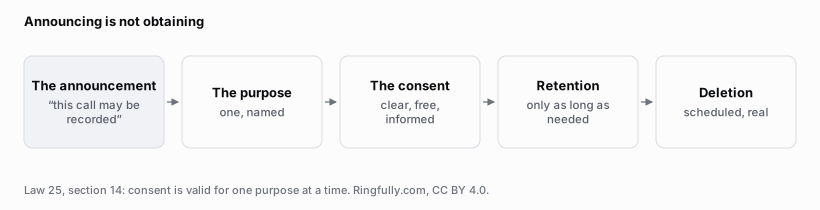
Announcing a recording and obtaining consent are different steps. Law 25 asks for both.
Reuse this figure anywhere, including commercially, with credit to Ringfully and a link back to this page. CC BY 4.0.
The first is the Criminal Code, which is federal. Section 184 makes it an offence to intercept a private communication, and paragraph 184(2)(a) exempts anyone who has the consent, express or implied, of the originator of the communication or of the person it was meant for. You are the person a call to your own business was meant for, so your own consent is the consent that paragraph asks for. That is the one-party consent rule, and it is why a private individual recording their own call is not committing an offence under that section.
A business does not get to stop there, because the recording is personal information about the caller. Section 14 of Quebec's private-sector privacy act, as Law 25 rewrote it, applies on top: consent "must be clear, free and informed and be given for specific purposes", requested at each of those purposes in clear and simple language, and it "is valid only for the time necessary to achieve the purposes for which it was requested". Consent not given that way "is without effect". So the Criminal Code answers whether you may listen, and Law 25 answers whether you may store, replay and use what you heard. The second one is the question a phone system actually has to be configured for.
The federal privacy commissioner arrives in the same place from the other side. Its guidance on recording customer telephone calls tells an organization to say that it is recording, to say why, and to use the recording only for the purpose it named. None of that is satisfied by a greeting that names no purpose.
What does Law 25 actually ask for?
Law 25 asks for consent that meets five conditions at once: manifest, free, informed, specific to a named purpose, and requested separately for each purpose. It amended Quebec's private-sector privacy act, and the consent provisions took effect in stages from September 2022. Consent is one of several obligations Law 25 places on a Quebec business; this article covers only that one. The Commission d'accès à l'information is the regulator.
Each condition means something particular. Consent must be:
- manifest: an actual, positive indication, not an absence of objection
- free: not bundled with something the person cannot decline
- informed: the person knows what is collected, by whom, and for how long
- specific: tied to a named purpose
- granular: requested separately for each purpose, not as one block
The last two matter most for a phone line, because "quality assurance" and "training" and "dispute evidence" are three purposes, not one. Consent obtained for the first does not carry the other two, which is why a written consent form ticks the purposes off one at a time. The form is one step of six; the Law 25 page walks the whole consent notice, from the decision to record to the day the recording is deleted.
Does a recording announcement count as consent?
An announcement is a disclosure, not a consent mechanism. It tells the caller what is happening. Whether staying on the line then constitutes consent depends on the situation:
| Situation | Announcement alone |
|---|---|
| Inbound call, caller chose to phone you | Often defensible: the caller can hang up |
| Outbound call you initiated | Weaker: the person did not choose the channel |
| Recording used for a new purpose later | Not sufficient. New purpose, new consent |
| Sensitive information discussed | Weaker. Higher expectations attach |
The practical reading is that an announcement plus a genuine option to continue or hang up covers ordinary inbound service calls, and does not cover repurposing a recording months later.
What this means when you configure a phone system
Three things are worth deciding before anyone answers a call: the purpose, who may play a recording back, and what happens to it afterwards.
Decide the purpose, then write it down
"This call may be recorded" names no purpose. "This call is recorded so we can check the quality of our service" names one. The second is what the law is asking for, and it is barely longer.
Decide who can play the recording back
Consent is bounded by purpose, and the purpose was not "anyone in the company can listen at any time". Permission to replay is part of the consent question, not separate from it.
Decide what happens to the recording
Retention is a purpose limitation too. A recording kept indefinitely has outlived any quality-assurance purpose it was collected under.
Where Ringfully is, honestly
Ringfully stores a per-organization recording announcement and lets you edit it, and it is spoken on the call. When it lands depends on the mode. In always mode the caller hears it before being connected, which is the last moment anything can be said off the recording. In the agent's-choice mode nothing is said at the start, because at that point nobody knows there will be a recording at all, and the announcement plays just after an agent starts recording rather than before. An empty field is silence: nothing is said, and the recording still runs. So what it should say is a field somebody has to fill in, and it has to satisfy Law 25 and the Charter at once. The modes and the failure cases are on our recording policy page.
We also do not decide your purpose for you, and no phone system can. Recording is off by default, and an organization that has not configured it does not record. Retention is settable rather than open-ended: an administrator sets how long recordings are kept, a nightly job deletes what has passed that window, and an organization that sets nothing runs on 30 days for recordings and 90 for voicemail. What we hold, who can reach it and what we still lack is listed on security.
This is a description of what the statute asks, not legal advice. Law 25 obligations depend on what you collect and why, and a Quebec-qualified adviser is the right person to confirm your position. If you want the mechanics of how a call is actually put together before recording enters the picture, how it works walks the path a call takes.
Questions people ask
- Is it legal to record a phone call in Quebec?
- Yes, if you are one of the parties to the call. The Criminal Code asks for the consent of one party, and you are that party when someone calls your own business. A business has a second question to answer, though, because the recording is personal information about the caller and Quebec's private-sector privacy law governs keeping it.
- Do I need the caller's permission to record the call?
- For the Criminal Code, no. For Law 25, yes: the recording is personal information, and collecting it needs consent that is manifest, free, informed, tied to a named purpose and requested separately for each purpose. Two statutes settle two different questions, and it is the second one a phone system has to be configured for.
- Does "this call may be recorded" count as consent?
- It is a disclosure, not a consent mechanism. The phrase names no purpose, and "may be" does not even confirm that recording is happening. An announcement plus a genuine chance to hang up is usually defensible on an ordinary inbound service call; it does not cover an outbound call you placed, and it does not cover reusing the recording for a purpose you never named.
- What should a recording announcement say?
- That the call is being recorded, and the purpose it is being recorded for. "This call is recorded so we can check the quality of our service" does both, and it is shorter than the usual wording. If you also record for training or for evidence of what was agreed, those are separate purposes and Law 25 asks for them to be consented to separately.
- How long can a business keep a call recording in Quebec?
- The statute sets no fixed period. The test is the purpose: once the purpose you collected the recording for is fulfilled, you have to destroy or anonymise it, unless another law imposes a retention period. A recording kept indefinitely has outlived the quality-assurance purpose it was announced under.
About the author
John
Owner and CEO
Owner and CEO with over 10 years of experience in the IT industry, including more than 5 years specializing in VoIP and cloud communications. Experienced in designing, deploying, and supporting reliable communication solutions for businesses.

Keep reading
A free tool for this, in your browser: the recording storage calculator.
If you are working out what Law 25 or Law 96 asks of your phone line, tell us what you record and who you serve, and we will say what we handle and what stays your job.