Blog
Recording announcements in Quebec: what to say
A recording announcement in Quebec satisfies two statutes: Law 25 wants a named purpose, and the Charter wants it in French. How to write one that does both.
John · Owner and CEO · 4 min read · · updated
A recording announcement on a Quebec business line has to do two jobs at once: name the purpose of the recording, which Law 25 asks for, and be delivered in French, which the Charter asks for. "This call may be recorded" fails the first and, delivered in English first, undercuts the second.
Most announcements in use today were written for neither statute.
What must a recording announcement contain?
Three things: that recording is happening, the purpose it is happening for, and enough for the caller to decide whether to continue. Consent has to be informed and tied to a specific purpose, and an announcement is not consent by itself, but it is where the information lives, so it has to carry:
- that recording is happening, not "may be"
- the purpose, named: quality, training, dispute evidence
- enough for the caller to decide whether to continue
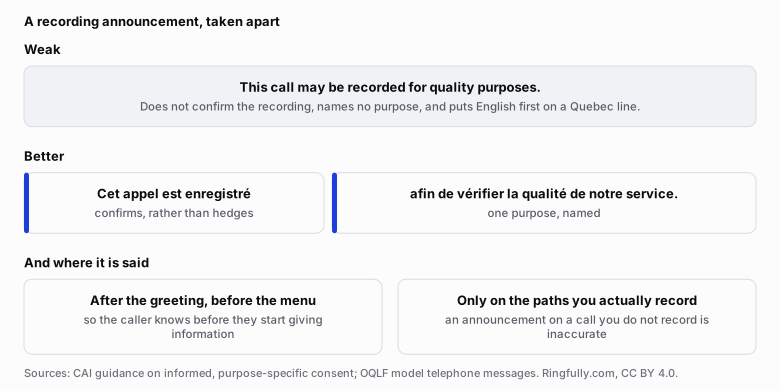
The model sentence does two things at once: it confirms that the recording is happening, and it names one purpose.
Reuse this figure anywhere, including commercially, with credit to Ringfully and a link back to this page. CC BY 4.0.
"May be recorded" is the standard phrasing and the weakest. It tells the caller nothing decidable: it neither confirms recording nor names why.
Which language must it be in?
It is part of telephone service, so it is in French, and the Office québécois de la langue française publishes model wording for the messages a business puts in its phone system. If your flow offers English, the English announcement lives in the English tree, not stacked in front of the French one.
The failure to avoid is announcing in English first because that recording was made years ago and never revisited.
Writing one
Weak:
This call may be recorded for quality purposes.
Better:
Cet appel est enregistré afin de vérifier la qualité de notre service.
The second confirms rather than hedges, names one purpose, and is shorter. If you record for more than one purpose, name them, and note that under Law 25 separate purposes need separately obtained consent, so a list in an announcement is not a shortcut around that; a consent form you can copy is where separate purposes get ticked one at a time. Where the announcement sits among the other obligations, and what Law 25 asks of the line as a whole, is on the Law 25 page.
Where it goes. After the greeting, before the menu: a caller should know before they start giving information, not after. And if only some calls are recorded, the announcement belongs on those paths, not on every call, because an announcement on a call you do not record is simply inaccurate.
The retention half nobody announces
Neither statute asks you to announce retention, but Law 25 limits how long you may keep the information for the purpose you named; retention sits alongside the other obligations Law 25 places on a Quebec business, announced or not. An announcement claiming quality assurance sits awkwardly next to a recording kept for three years, and the announcement is the thing a complainant will quote back.
Where Ringfully is, honestly
Ringfully stores a per-organization recording announcement and lets you edit it, and it is played on the call. The wording above is therefore the wording a caller hears, in French or in whatever language you wrote it. Two things qualify that. In always mode the announcement plays before the caller is connected. In the agent's-choice mode nothing is said at the start, because nobody yet knows there will be a recording, and the announcement plays just after an agent starts recording rather than before, which is the ordering to weigh if your notice has to precede every recorded second. And an empty field is silence: nothing is said, and the recording still runs, so the Law 25 information duty is discharged by the sentence you write and not by the field existing.
That is stated on our recording policy rather than left for you to find. An organization that has not enabled recording does not record, and replay is permission-gated. Recordings are also deleted on a schedule: an administrator sets a retention window per class of data, and a nightly job removes whatever has passed it.
We would rather you knew all of that before configuring anything. The rest of what we hold, and what we still lack, is on security.
A description of what the statutes ask, not legal advice. Announcement wording that satisfies two regimes at once is worth ten minutes with a Quebec-qualified adviser. Related: consent under Law 25.
Questions people ask
- What should a call recording announcement say in Quebec?
- That the call is being recorded, and the purpose it is being recorded for. "Cet appel est enregistré afin de vérifier la qualité de notre service" does both in one line. "This call may be recorded" does neither: it hedges on whether recording is happening at all, and it names no reason.
- Is "this call may be recorded" enough?
- No, on two counts. Consent under Law 25 has to be informed and tied to a specific purpose, and "may be" names no purpose and does not confirm the recording. Delivered in English first on a Quebec line, it also puts the wrong language in front.
- Where in the call should the announcement play?
- After the greeting and before the menu, so the caller knows before they start giving information rather than after. If only some calls are recorded, the announcement belongs on those paths and not on every call: an announcement on a call you do not record is simply inaccurate.
- Does the recording announcement have to be in French?
- It is part of telephone service, so yes. If your menu offers English, the English announcement lives inside the English branch rather than stacked in front of the French one. The Office québécois de la langue française publishes model wording for the messages a business puts in its phone system, which is a better starting point than a translation.
- Do I have to say how long the recording is kept?
- Neither statute asks you to announce retention. Law 25 does limit how long you may keep the recording for the purpose you named, though, so an announcement claiming quality assurance sits awkwardly beside a recording held for three years. The announcement is the sentence a complainant will quote back to you.
About the author
John
Owner and CEO
Owner and CEO with over 10 years of experience in the IT industry, including more than 5 years specializing in VoIP and cloud communications. Experienced in designing, deploying, and supporting reliable communication solutions for businesses.

Keep reading
If you are working out what Law 25 or Law 96 asks of your phone line, tell us what you record and who you serve, and we will say what we handle and what stays your job.