Blog
Change your auto attendant menu yourself
How changing your own auto attendant menu should work, what happens to a caller who is already in the old one, and what publish refuses to put live for you.
John · Owner and CEO · 5 min read · · updated
You should be able to change your own phone menu on a Tuesday afternoon: draw the change, press publish, and callers already on the line finish the menu they started while new callers get the new one. In Quebec, the first thing they hear must still be French.
Draw it, then publish it
The usual story: the menu was set up once, by somebody, and it has been wrong since the new hire started. Changing it means calling the phone company, describing the change over the phone, and waiting. So the wrong name stays for months.
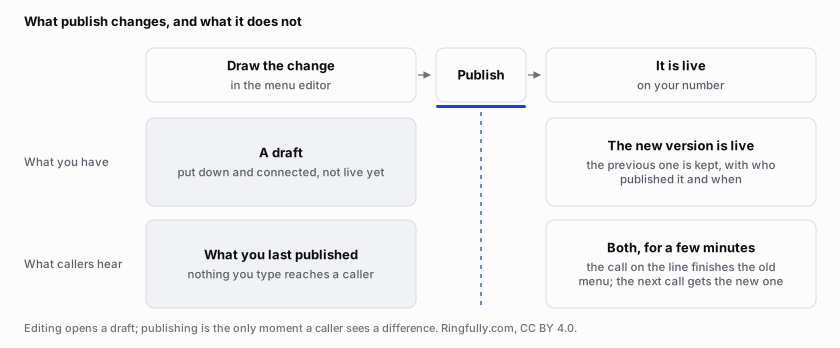
Draw it, publish it, it is live. What the publish moment changes, on either side of it.
Reuse this figure anywhere, including commercially, with credit to Ringfully and a link back to this page. CC BY 4.0.
The menu editor is a page where you put steps down (by clicking as well as by dragging) and connect them: a greeting, a choice, your hours, a hand-off to a team, voicemail. You can start from a ready-made menu rather than a blank page.
Editing the menu that is already answering your phone does not change what callers hear. It opens a draft, and your number goes on answering with what you last published. Nothing you type reaches a caller until you press publish, so the editor is a place to think out loud.
Every step that says something can be text read aloud in a voice you pick, or a recording you upload, with the voice and the language set on that step. Correcting “press 2 for the clinic” is retyping one sentence.
What happens to a caller who is already in the menu?
Nothing changes for them. A published menu is frozen: when a call comes in it is tied to whichever version is live at that moment, and it stays on that version to the end. The caller already in the old menu finishes on it; the next call gets the new one.
The fear is understandable, because on most systems the question has no good answer. Here two versions can be answering at once for a few minutes, and neither caller notices.
Underneath, the auto attendant (the IVR) runs on our own software rather than a phone company’s, and a published version is never edited in place, which is what makes that promise keepable. Every version is kept, with who published it and when. When something has gone wrong, the question is usually “what did people hear on Tuesday afternoon?”, and that is a question the history can answer.
What will publish refuse to put live?
Publish checks the menu before it goes live and refuses four things outright:
- A menu with no beginning, so a call would have nowhere to start.
- A step with a required setting left empty: a choice that says nothing, or a hand-off to a team somebody deleted last month.
- A step that cannot run where you put it. What callers hear while they wait is its own short menu, and a hand-off does not belong in it.
- A step set to dial an emergency number, including near-misses like 1911, because a caller who got there through a menu would give a dispatcher no location and nobody to talk to.
One thing it points out but does not refuse: an exit with nothing connected to it. That usually means “and then hang up”, so the message says whether the call ends there or follows another exit, and lets you decide.
Each refusal names the step in the editor, so it is something you can fix rather than a list of complaints.
French first is a structure, not a recording
If you serve the public in Quebec, the first thing a caller hears is French. That is a matter of how the menu is built, not of which recording you upload. The Office québécois de la langue française's model greeting for a centralized telephone service puts the same order in writing: French, one brief instruction for the other language, then French again.
The structure that works is one French menu, with the other language offered briefly at the top and everything after that choice spoken in the language the caller picked. Not two full menus behind a language gate. Why French first is a structure walks through the two shapes side by side.
For changing a menu, the consequence is simple: a new prompt is one French sentence and, if you offer English, one English sentence, each with its own voice and language on its own step. Publish checks both the same way.
What we do, and what we do not
We build the menu with you at setup. After that you change it yourself, and nobody at Ringfully edits it for you unless you ask. The menu editor and what publish refuses is the full description.
There is no undo after publish. What there is: every version is kept, and going back means publishing the previous one again. It is copied forward into a new draft rather than rewound, so the history stays a record of what callers actually heard.
You cannot schedule a change for a future date. Publishing happens when you press publish; if a change should land after closing, somebody presses the button then. Time itself is handled by your hours, your holidays and the “we are closed right now” switch, which is set once and left alone rather than republished every season.
This is about changing a menu safely. Designing one in the first place, and what the Charter of the French Language adds to it, is building a phone menu callers do not hang up on.
Questions people ask
- Can I change the phone menu myself?
- Yes. You put the steps down, connect them and press publish. Nobody at Ringfully edits your menu for you unless you ask, and there is no phone company to call first.
- What happens to a caller who is already in the menu when I publish?
- Nothing changes for them. A call is tied to whichever version was live when it arrived and stays on that version to the end. The next call gets the new one, and two versions can be answering at once for a few minutes.
- Does editing the menu change what callers hear right away?
- No. Editing opens a draft, and your number goes on answering with what you last published. Nothing you type reaches a caller until you press publish.
- What will publish refuse to put live?
- A menu with no beginning, a step with a required setting left empty, a step that cannot run where you put it, and any step set to dial an emergency number, including near misses like 1911. Each refusal names the step in the editor.
- Is there an undo after publish?
- Not as such. Every version is kept, with who published it and when, and going back means publishing the previous one again. It is copied forward into a new draft rather than rewound.
- Can I schedule a menu change for a future date?
- No. Publishing happens when you press publish. Time itself is handled by your hours, your holidays and the we are closed right now switch, rather than by scheduling a republish.
About the author
John
Owner and CEO
Owner and CEO with over 10 years of experience in the IT industry, including more than 5 years specializing in VoIP and cloud communications. Experienced in designing, deploying, and supporting reliable communication solutions for businesses.

Keep reading
A free tool for this, in your browser: the phone menu builder.
If your phone menu sends people to the wrong place, or the wrong message plays after hours, describe what a caller hears today and we will tell you how we would set it up.