Blog
French-first IVR that still serves anglophones
A bilingual menu and a French-first menu are different structures. One offers a choice; the other has a default. Quebec's Charter asks for the second.
John · Owner and CEO · 3 min read · · updated
A French-first phone menu answers in French, offers English in a single short line, and sends a caller who does nothing into French service. A bilingual menu presents both languages as equals. Under Quebec's Charter, the first structure is the one to build, and the difference is entirely in where the default sits.
Here is how to build it without making anglophone callers feel handled badly.
The two structures, side by side
| Bilingual menu | French-first | |
|---|---|---|
| First words heard | Often English, then French | French |
| Doing nothing leads to | Often a repeat, then default | French service |
| English offer | A full parallel menu | One short line |
| Time to reach a person, French | Longer: you sat through both | Shorter |
| Time to reach a person, English | Shorter | One extra step |
The bilingual menu costs your francophone callers time in order to save it for anglophone ones. French-first reverses that, and one extra keypress is a small price for the caller who takes the option.
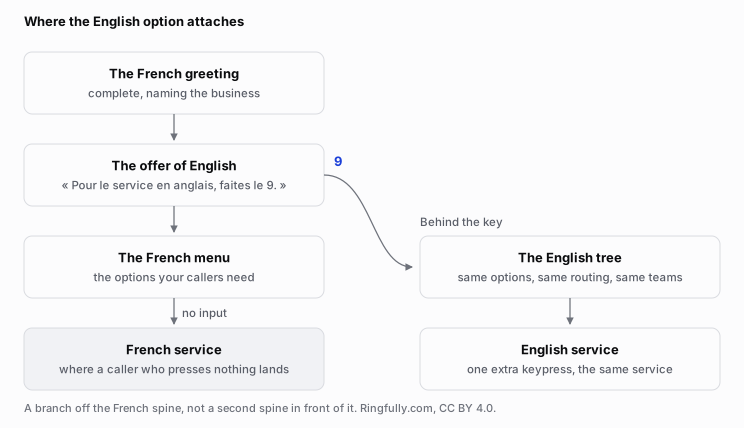
The English option is a branch off the French spine, not a second spine in front of it: a caller who presses nothing stays in French.
Reuse this figure anywhere, including commercially, with credit to Ringfully and a link back to this page. CC BY 4.0.
A structure that works
Five steps, in this order: a French greeting, one short line offering English, the French menu, the English tree behind the digit, and a timeout that lands in French.
The greeting
Normal French, complete, naming the business. Nothing about language yet: a caller who reached the right place should hear that first.
The offer, once and short
Something on the order of "Pour le service en anglais, faites le 9." One line, which is the shape the Office québécois de la langue française sets out in its model greeting for a centralized telephone service: the message opens in French, gives a brief instruction for service in the other language, then returns to French. Placed after the greeting and before the menu, so the anglophone caller does not have to sit through a French menu to discover the option, and the francophone caller loses about two seconds.
The French menu
The real one, with the options your callers actually need.
The English tree
Behind the digit, a complete equivalent: same options, same routing, same queues.
The timeout
This is the part that decides whether you are actually French-first. A caller who presses nothing should land in French service. Repeating the greeting once and then routing to a French queue is the behaviour; sending them to a bilingual "please choose" loop is not.
The mistakes worth naming
Putting the English offer first. The commonest one, usually inherited from a system configured before the obligation existed. The first thing heard is the default, whatever the menu says afterwards.
Making English the shorter path. If English reaches a human in two steps and French takes four, the structure says something the greeting does not.
Forgetting the branches. Voicemail greetings, hold messages, after-hours announcements and callback prompts are all part of "telephone service", and the Office keeps writing guidance on telephone communications covering each of them in turn. A French-first main menu that hands off to an English voicemail greeting has moved the problem rather than solved it.
Leaving the queue announcements in one language. Position-in-queue and estimated-wait messages sit inside the wait, which is exactly where a caller is most likely to give up.
Where Ringfully is
Flows are built as a graph, so the structure above is the ordinary way to build rather than a workaround: a greeting block, a menu with one digit routed to a separate English subtree, and a timeout exit you set explicitly. Sub-flows mean the English tree can be maintained as its own thing instead of duplicated inside the French one. The blocks this uses are described on call menus and hours.
Business hours, holidays and closures attach per location, so a Quebec number can follow the Quebec calendar while another follows its own. Quebec statutory holidays covers that side.
The honest limit: we do not supply audio. Greetings, hold music and announcements are yours to record or generate, in whichever language. If you would rather have this shape built with you the first time, tell us how your line answers today.
A description of what the Charter of the French language asks, not legal advice. Confirm your obligations with a Quebec-qualified adviser. Related: Law 96 and your phone system.
Questions people ask
- What does a caller hear first on a French-first phone menu?
- Your French greeting, complete, naming the business. The offer of English comes after it as one short line, and the menu comes after that. Nothing is said about language before the caller knows they reached the right place.
- What happens if the caller presses nothing?
- On a French-first menu they end up in French service. That is the test of the structure: repeat the greeting once, then route to a French-speaking team. A caller who presses nothing and lands in a bilingual please-choose loop is on a bilingual menu, whatever the greeting says.
- Can I still serve my English-speaking customers properly?
- Yes. Behind the digit you build a complete English branch: the same options, the same routing, the same teams. The anglophone caller pays one extra keypress and gets the same service.
- Do voicemail and hold messages have to be in French too?
- They are part of your telephone service, so yes. A French main menu that hands off to an English voicemail greeting has moved the problem rather than solved it. The same goes for after-hours announcements, wait messages and callback prompts.
- Does Ringfully record the French audio for me?
- No. Greetings, hold music and announcements are yours to record or to generate, in whichever language. We give you the steps that carry them, with the voice and the language set on each step.
About the author
John
Owner and CEO
Owner and CEO with over 10 years of experience in the IT industry, including more than 5 years specializing in VoIP and cloud communications. Experienced in designing, deploying, and supporting reliable communication solutions for businesses.

Keep reading
A free tool for this, in your browser: the phone menu builder.
If your phone menu sends people to the wrong place, or the wrong message plays after hours, describe what a caller hears today and we will tell you how we would set it up.