Blog
Missed calls while everyone is with a customer
Why calls go missing when everyone is with a customer, what a waiting caller should hear instead, and how “press 1 and we ring you back” really works.
John · Owner and CEO · 4 min read · · updated
When nobody is free, the caller should hear that they are in a line, then music, then roughly how long, then an offer to press 1 and be rung back, in that order. A line that rings every phone at once and gives up after thirty seconds is exactly how a call becomes a missed call.
Why does ringing every phone at once lose callers?
Ring-all works while somebody is free and fails the moment nobody is. In a business of two to twenty people, the most common setting is also the simplest: a call rings every phone at once. When somebody is free, it works. When everyone is with a customer, four phones ring into the air for thirty seconds, then the call drops into voicemail or simply cuts off.
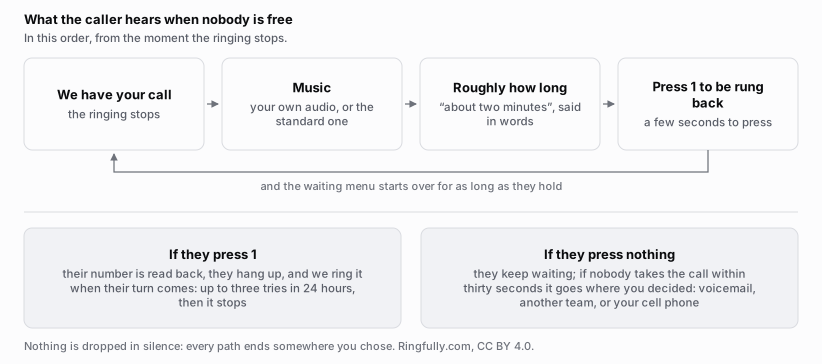
The ringing stops first; everything else the caller hears is there to make the wait a choice rather than a guess.
Reuse this figure anywhere, including commercially, with credit to Ringfully and a link back to this page. CC BY 4.0.
The caller hears nothing but ringing. Nothing tells them they have been seen, nothing says how long it will take, nothing gives them a choice. They hang up around the fifth ring, and often they do not call back.
That is what a small business’s missed calls look like: not a call in the night, a call at 10:15 on a Tuesday, while everyone was working.
The four things a waiting caller should hear
A patient caller is not someone who enjoys waiting. It is someone who knows where they stand. Four things, in this order, are enough to keep them on the line.
That you have their call
One sentence, in their language: we have your call, someone will answer as soon as possible. The ringing stops and the wait begins.
Music
Your own audio if you have some, otherwise the standard hold music. What makes people hang up is silence, not length.
Roughly how long
“About two minutes”, said in words, never in seconds. When there is no usable estimate, saying nothing beats announcing a wrong figure: people set their patience by that sentence.
The choice not to wait
Press 1 and we ring you back. The message leaves a few seconds to press; if the caller presses nothing, they simply keep waiting. Silence is not a refusal, it is somebody who has not decided yet.
How does “press 1 and we ring you back” actually work?
The system notes the number the call came from, reads it back, hangs up, and rings that number itself when the caller's turn comes, without anyone in your office having to remember. A promise to call back is worth whatever keeps it, so the detail matters.
The number the call came from is noted and read back aloud, so the person knows we have the right one. They hang up. The system rings them back on its own, with nobody in your office having to remember. If there is no answer, it tries again, up to three attempts within 24 hours, then stops: a number that never answers is not a fault, and a call out of nowhere the next day is worse than no call.
When the person picks up, they enter the same team’s wait as an ordinary call, with the same rules: who may take the call, which calls go first. They are not handled separately; they simply kept their place without keeping the line.
The wait itself has a limit. When nobody picks up in time, the call goes where you decided: voicemail, or an outside number such as your cell phone. Nobody waits indefinitely.
Underneath, each team is a queue with its own short menu for the wait, and that menu starts over for as long as the person waits. Once somebody is on the line, what follows belongs to assisted transfer and hold, not to the wait.
When the wait itself is the problem
If your callers wait every day at the same hour, no setting is wrong. That is a schedule. The clinic’s Monday morning, the workshop’s Friday afternoon: a good waiting menu makes those hours bearable, it does not make them disappear.
Before touching the messages, look at the week. If Tuesday at ten overflows every week, the answer is one more person on Tuesday at ten, not longer music. The automatic callback buys you time; it does not create availability. The post on teams and who takes which calls takes that distinction further.
What we do, and what we do not
At Ringfully, a team decides who may take its calls and which calls go first, and what the caller hears while waiting is set step by step, in the order you choose. The detail is on the teams and waiting page.
What we do not do, said plainly:
- No “we missed your call” text message is sent. The callback is a call, nothing else.
- No position is announced. The caller hears a rough duration, never “you are third in line”.
- The callback needs a number the system can dial. A withheld number cannot be rung back; in that case the caller keeps waiting, without being promised something that will not happen.
Related: how one published number reaches sales, service and billing. If calls go missing at the same hour every week, tell us what your week looks like.
Questions people ask
- What happens to a call when everyone is with a customer?
- Instead of ringing out, the caller enters the wait for the team the menu chose. They hear that you have their call, then music, then roughly how long, then the offer to press 1 and be rung back. The ringing stops, and that is the part that keeps people on the line.
- How does press 1 and we ring you back actually work?
- The system notes the number the call came from, reads it back out loud so the caller can hear it is right, and lets them hang up. It rings that number itself when the turn comes. If nobody answers it tries again, up to three attempts within 24 hours, and then it stops.
- Does the caller lose their place if they ask for a callback?
- No. When they pick up the callback they enter the same team's wait as an ordinary call, with the same rules about who may take it and which calls go first. They kept their place without keeping the line.
- Is the caller told their position in the line?
- No. They hear a rough duration said in words, about two minutes or less than a minute, and nothing at all when there is no usable estimate. A wrong figure is worse than none, because people set their patience by that sentence.
- What happens if nobody picks up at all?
- The wait is bounded. A call is offered for thirty seconds, and when nobody takes it the caller goes where you decided: voicemail, another team, an outside number such as your cell phone, or a message and a goodbye. Nothing is dropped in silence.
About the author
John
Owner and CEO
Owner and CEO with over 10 years of experience in the IT industry, including more than 5 years specializing in VoIP and cloud communications. Experienced in designing, deploying, and supporting reliable communication solutions for businesses.

Keep reading
A free tool for this, in your browser: the Erlang C calculator.
If calls ring out while everyone is with a customer, tell us how many people answer and what kinds of call come in, and we will set the teams up with you.