Blog
Surprise phone bill: toll fraud and a ceiling
Where a surprise phone bill comes from, why a warning from your provider is not protection, and what a monthly spend ceiling actually does when it is reached.
John · Owner and CEO · 4 min read · · updated
A surprise phone bill is usually calls you did not place: made overnight, to premium numbers, through a stolen password or an old voicemail box. The protection that works is a monthly ceiling the system itself enforces. When it is reached, outbound calling and messaging stop.
Where do the calls on a surprise bill come from?
They come in through one of three doors, and all three are yours rather than the network's. Nobody at your shop dialled a premium number in another country at three in the morning; something did, on your account, and the bill has your name on it.
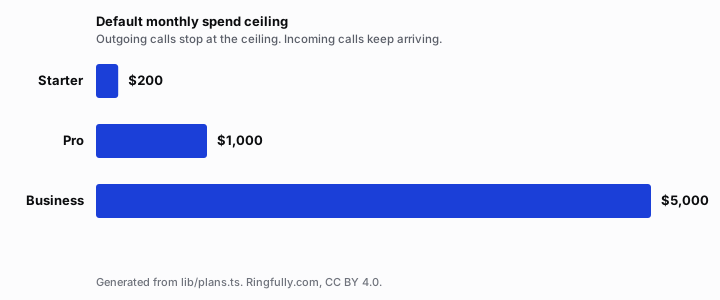
The ceiling on each plan, generated from the same file the pricing page reads.
Reuse this figure anywhere, including commercially, with credit to Ringfully and a link back to this page. CC BY 4.0.
- A login with a weak or reused password, guessed or bought.
- A voicemail box still on its default code, on a system that lets a caller dial out from inside it.
- A line forwarded to an outside number, and the outside number is expensive.
The calls run when nobody is watching: nights, weekends, the long weekend. They are short, they are many, and each one is worth a little to whoever owns the premium number at the far end. The old PBX in the closet is where the classic version lives; moving off a PBX or Centrex is often the moment a business finds out what its old box let through.
Why is a warning from your provider not protection?
Because a warning depends on somebody being awake to act on it. Most providers will tell you something is wrong: an email, a line on the invoice, a call from the account manager on Monday. By then the calls have been running for two days.
Someone has to read it, understand it, sign in and turn something off, at an hour when nobody is at work. Protection that needs a human awake at three in the morning is not protection. It is a notification.
A ceiling is different in kind: an amount the system will not spend past, enforced on every outbound call whether or not anyone is reading email.
What a ceiling does, at each plan's amount
Every plan has a monthly spend ceiling: on Ringfully the ceiling is $200, $1,000 or $5,000 a month depending on the plan. Your seat price includes an allowance of minutes; past that allowance, calls cost the published rate of 3.0¢, 2.5¢ or 2.0¢ per minute, and every one of those minutes counts toward the ceiling. Calls between colleagues cost nothing and do not move the meter.
You get two notices, at 80% and at 100%. At the ceiling, the system refuses every outbound call and every outbound text message with the same sentence, “This account has reached its monthly spending limit.” Incoming calls keep arriving. The account simply cannot spend more until an administrator raises the ceiling.
The cost of a bad night is bounded by a number you chose, not by how long it took someone to notice. The full table of allowances and rates is on the pricing page.
The three habits that close the door
A ceiling caps the damage. Three habits mean it rarely has to.
Strong passwords, and sign out
A stolen login is the usual door. Use a password that is not used anywhere else, and sign out of the phone on a shared computer at the end of the day.
Remove people the day they leave
A former employee who can still sign in is a login you no longer control. Removing a person's access when they leave explains the order to do it in.
Do not forward a line to a number you do not recognize
Forwarding to a colleague's cell phone is normal. Forwarding to a foreign or premium number that nobody on your team can explain is the fraud itself, dressed up as a setting.
What we do, and what we do not
We enforce a monthly spend ceiling on every plan, at the amount above, and we send the two notices. At the ceiling, outbound calls and outbound text messages stop; incoming calls do not. An administrator can raise it at any time. That is the whole mechanism.
Here is what is not in it. There is no list of countries you are allowed to dial, so a call to any destination goes through until the ceiling. There is no fraud scoring, and no automatic detection of calls at odd hours: the system does not know that three in the morning is strange for you. A ceiling stops the bill from growing; it does not get back what was spent before it was reached. And once reached, it stops your legitimate outbound calls too, until someone raises it.
Among what a cloud phone system changes for a small Quebec business, this is one of the quieter ones: the bill has an upper bound before the month starts.
The ceiling is set with you before the first call goes out, and an administrator can move it afterwards without waiting for anyone here.
Questions people ask
- Why is my business phone bill suddenly so high?
- Usually because of calls nobody at your business placed: made overnight, to premium numbers abroad, through a stolen login, a voicemail box still on its default code, or a line forwarded somewhere expensive. They are short, they are many, and each one pays whoever owns the number at the far end.
- What is a spend ceiling on a phone system?
- A monthly amount the system will not spend past, enforced on every outbound call and text message whether or not anyone is reading email. Every Ringfully plan has one, and the amount depends on the plan and is published on the pricing page. At the ceiling, outbound calling and messaging stop and incoming calls keep arriving.
- Is a fraud warning from my provider enough protection?
- No. A warning depends on somebody being awake to read it, understand it, sign in and turn something off, at three in the morning on a long weekend. By the time it is acted on the calls have been running for two days. Protection that needs a human awake at that hour is a notification, not protection.
- How do I stop a stolen login running up a bill?
- Set a monthly ceiling so the damage is bounded before it happens, then close the doors: passwords that are not reused anywhere else, signing out of shared computers, removing people the day they leave, and never forwarding a line to a number nobody on your team can explain. The ceiling is the part that keeps working while nobody is watching.
- What happens when the spend ceiling is reached?
- Outbound calls and outbound text messages are refused, with a message saying the account has reached its monthly spending limit. Incoming calls are unaffected. Two notices arrive on the way there, and an administrator can raise the ceiling at any time.
About the author
John
Owner and CEO
Owner and CEO with over 10 years of experience in the IT industry, including more than 5 years specializing in VoIP and cloud communications. Experienced in designing, deploying, and supporting reliable communication solutions for businesses.

Keep reading
A free tool for this, in your browser: the phone cost comparator.
If you are weighing a cloud phone system for a small team, tell us what your current one does that annoys you most, and we will say plainly whether ours changes it.