Blog
After-hours call handling: three honest options
The sequence a call takes after closing time, and the three destinations that work for a small business: a reopening message, voicemail, or an outside number.
John · Owner and CEO · 5 min read · · updated
After-hours call handling is a sequence: after closing, a call should meet your hours before it meets a ringing phone, then take one of three honest paths: a message with the reopening time, voicemail that reaches the team, or a hand-off to a real outside number such as an on-call cell. Anything else is a phone ringing in an empty room.
What happens to a call after closing time?
After closing, a call meets your hours before it meets a ringing phone. The call arrives, your phone menu checks the time against your opening hours, and the answer decides the rest: open, the call carries on to your team; closed, it takes the closed exit, and the closed exit leads to whatever you put there.
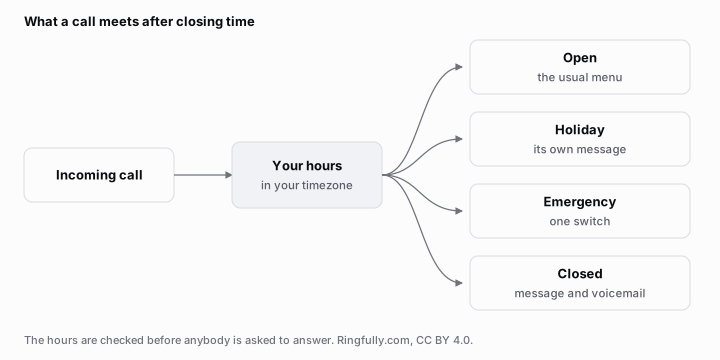
The hours are checked before anybody is asked to answer, which is why a caller at nine in the evening hears the closed message straight away.
Reuse this figure anywhere, including commercially, with credit to Ringfully and a link back to this page. CC BY 4.0.
The order is the whole trick. If the phone rings first and the hours are checked afterwards, the caller has already listened to several rings into an empty office before hearing that you are closed. If the hours are checked first, the caller hears the right thing straight away.
There is no separate night mode to switch on at five o'clock. Closed is simply what your schedule says outside the hours you entered, and the menu follows it every evening and every weekend without anybody touching anything. (A snow day is a different switch, the “we are closed right now” switch, covered in what to say on an unexpected closure.)
Which destination should go on the closed exit?
Pick by whether anything said after closing changes what happens in the morning: a reopening message when it does not, voicemail when the evening call is a job to book, and an outside number when somebody genuinely is reachable.
| Closed exit | Suits | What the caller gets | What it asks of you |
|---|---|---|---|
| A message with the reopening time | A shop or clinic where nothing said at night changes the morning | Your hours and when you reopen, then the call ends | Nothing in the morning |
| Voicemail that reaches the team | A trade or agency where the evening call is a job to book | To leave a message, with a notice reaching the team | Somebody has to act on it |
| A real outside number | A business where somebody genuinely is reachable after hours | A phone that rings, with a no-answer exit behind it | Minutes metered at the published rate, and editing the menu when the on-call person changes |
Say when you reopen, and hang up
The plainest option, and often the right one. The caller hears your hours and when you reopen, and the call ends. No message left, nothing to check in the morning.
It suits a shop or a clinic where nothing said at nine at night changes what happens at eight the next morning.
The message should carry the reopening time, not just “we are closed”. “We are closed” tells the caller what they already guessed. “We reopen tomorrow at eight” tells them what to do. The post on building a phone menu callers stay on covers the wording of the greeting itself; the after-hours version follows the same rules, shorter.
Voicemail that reaches the team
The second option is to take a message, on one condition: somebody has to find out about it. A voicemail box that fills up quietly is the reopening message with extra steps and a worse morning.
With Ringfully, messages land in one shared company inbox, and a notice reaches the team with the caller's number and a link to listen. Where a message goes from there, and who hears about it, has its own post.
It suits a trade or an agency where the evening call is a job to book, not an emergency, and a call back at nine the next morning is a fine answer.
Ring an outside number
The third option is for the business where somebody really is reachable after hours: a plumber's on-call cell, the owner's phone, an answering service you already pay for. The closed exit hands the call to a real outside number and lets it ring there.
In the menu, this is the “Transfer to a person” step with “An outside phone number” as its destination: a full number in international format. Emergency numbers are refused there, on purpose. If nobody picks up on that phone either, the step has a no-answer exit (underneath, the dial timeout on that outside leg), so you can put a message or voicemail behind it rather than letting the call ring out twice.
Two things to know before you choose it. Minutes on that outside leg count against your plan's allowance like any other external call, so an evening of long calls is metered at the published rate. And the step holds one number. If the person on call changes on Thursday, somebody edits the menu and presses publish.
An answering service is simply an outside number to us. We do not provide one, and we do not need to know that it is one.
What we do, and what we do not
Your hours run first, before any phone rings, and the closed exit takes one of the three paths above. That is the call menus and hours page in one sentence.
What we do not do. There is no rotation of on-call numbers by day: one outside number per step, and changing who is on call means editing the menu and publishing it again. We do not send the caller a text message when they reach the closed exit. The outside leg is metered, not treated as an internal call. And we do not run an answering service ourselves; if you have one, it is a number you give us.
Related reading: where the holiday calendar lives, so the line closes on the right days.
Questions people ask
- What happens to a call at 6pm?
- It meets your hours before it meets a ringing phone. The call arrives, your phone menu compares the time with your opening hours, and the closed exit leads to whatever you put there: a message with your reopening time, voicemail, or an outside number.
- Do I have to switch something on at closing time?
- No. There is no night mode. Closed is simply what your schedule says outside the hours you entered, and the menu follows it every evening and every weekend without anybody touching it.
- Can the phone ring my cell after hours?
- Yes. The closed exit can hand the call to a full outside number in international format and let it ring there. If nobody picks up, that step has its own no-answer exit, so a message or voicemail can sit behind it.
- Do after-hours calls to my cell cost extra?
- They count against your plan's minute allowance like any other call to the outside world, and past the allowance they are billed at the published rate. Calls between colleagues are not counted at all.
- Who is told when someone leaves a message overnight?
- Everyone on your team who has the right to listen. The message lands in one shared inbox for the company, and a notice goes out with the caller number, the time of the call and a link to listen.
- Can the on-call number change by day of the week?
- Not on its own. The step holds one number, so when the person on call changes somebody edits the menu and presses publish. There is no rotation by day.
About the author
John
Owner and CEO
Owner and CEO with over 10 years of experience in the IT industry, including more than 5 years specializing in VoIP and cloud communications. Experienced in designing, deploying, and supporting reliable communication solutions for businesses.

Keep reading
A free tool for this, in your browser: the phone menu builder.
If your phone menu sends people to the wrong place, or the wrong message plays after hours, describe what a caller hears today and we will tell you how we would set it up.