Blog
How long may the “for English” message be?
Quebec guidance says the message offering service in another language should be brief and should say who can be served in it. How to write one that fits.
John · Owner and CEO · 3 min read · · updated
Public guidance on Quebec's Charter is that the message offering service in another language should run only a few seconds and should say who can be served in it. No second count is published, so the practical test is proportion: a brief aside after a full French greeting.
Why does brevity matter?
The obligation, under the Charter of the French language, is to serve in French. A short offer of another language is compatible with that; a second full menu of equal weight is not, because it re-establishes the two languages as equals and removes the default the Charter is creating.
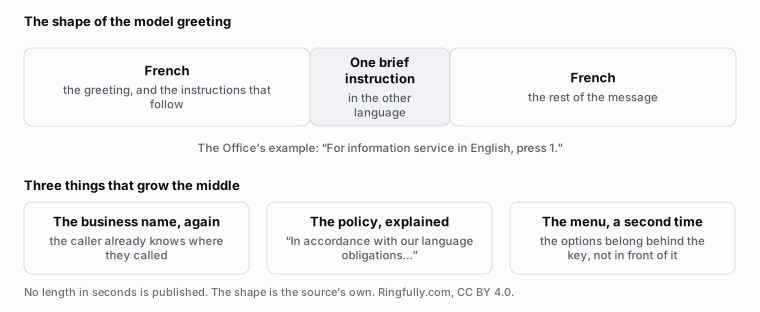
The model greeting published by the Office québécois de la langue française opens in French, gives one brief instruction for service in the other language, and returns to French.
Reuse this figure anywhere, including commercially, with credit to Ringfully and a link back to this page. CC BY 4.0.
So the question is not really "how many seconds". It is whether a caller who does nothing ends up in French, and whether the English offer reads as an accommodation rather than a parallel front door.
Writing one that fits
One sentence carries the whole message: name the language, name the key, and stop.
Pour le service en anglais, faites le 9.
Five words and a digit. It names what is offered and how to get it, and nothing else. The Office québécois de la langue française's model greeting for a centralized telephone service is built the same way: French, one brief instruction for service in the other language, then French again. Four rules keep it that short.
Do not repeat the greeting in English
The commonest way these grow is re-announcing the business name in the second language. The caller already knows where they called.
Do not explain the policy
"In accordance with our language obligations…" is longer than the offer it introduces, and no caller is helped by it.
Do not list the menu twice
If the English tree has six options, they belong behind the digit, not in front of it.
Put it after the greeting, before the menu
After, because the greeting is the French service being offered. Before, because an anglophone caller should not have to sit through six French options to discover there was an English one.
Where to put it in the flow
Greeting (French, complete)
  → "Pour le service en anglais, faites le 9."
    → French menu
      → timeout / no input → French queue
    → 9 → English tree
The line that matters most is the timeout. If no input lands the caller in French service, the structure is French-first regardless of how the English offer is worded. If no input drops them into a bilingual retry loop, the wording will not save it.
A note on voice
Guidance points at francophone audio throughout, so a French greeting read in a markedly non-Quebec accent, or a synthetic voice trained on European French, is worth a listen before you ship it. This is not a legal threshold anyone publishes: it is the difference between a caller feeling served in French and feeling processed in it.
Where Ringfully is
The structure above is built the ordinary way: a greeting block, a menu with one digit routed to a sub-flow, and an explicit timeout exit. Because the timeout exit is a real port on the block rather than an implicit fallback, "what happens when the caller does nothing" is a decision you make rather than one you inherit.
We do not supply the audio. The greeting, the offer and the menu prompts are recordings or generated speech you provide. The blocks they sit on are described on call menus and hours. If you want a second pair of ears on the wording before it goes live, send us what your line says today.
A description of published guidance, not legal advice, and there is no official second count to cite. Confirm your obligations with a Quebec-qualified adviser. Related: building a French-first IVR, and what Law 96 asks of a phone line.
Questions people ask
- How many seconds may the for English message be?
- No official number is published. The guidance asks for a brief instruction, a few seconds, after a complete French greeting. In practice one sentence naming the language and the key is the whole message.
- What should the English offer actually say?
- Name the language, name the key, and stop. Pour le service en anglais, faites le 9 is five words and a digit. It says what is offered and how to get it, and nothing else.
- Where in the menu does it go?
- After the greeting and before the menu. After, because the greeting is the French service being offered. Before, because an anglophone caller should not sit through six French options to discover there was an English one.
- Do I have to repeat my business name in English?
- No, and it is the commonest way these messages grow. The caller already knows where they called. Re-announcing the business in the second language doubles the length of the offer and helps nobody.
- Does the wording matter more than the timeout?
- No. The timeout decides whether the menu is French-first. If a caller who presses nothing lands in French service, the structure holds however the offer is worded. If it drops them into a bilingual retry loop, no wording saves it.
About the author
John
Owner and CEO
Owner and CEO with over 10 years of experience in the IT industry, including more than 5 years specializing in VoIP and cloud communications. Experienced in designing, deploying, and supporting reliable communication solutions for businesses.

Keep reading
A free tool for this, in your browser: the phone menu builder.
If your phone menu sends people to the wrong place, or the wrong message plays after hours, describe what a caller hears today and we will tell you how we would set it up.